Showing posts with label Indian wine. Show all posts

Tuesday, 15 March 2011

Sula Vineyards Pt. 2


And another thing. 


I also tried some of Sula's Sauvignon Blanc, this time at a staggeringly chi-chi boutique hotel in northern Goa, and it was fine, tasting pretty much of Sauvignon Blanc, a touch of wine gums and frangipani (I averred theatrically at the time), still the equivalent of £20 a bottle, but something was missing.


Couldn't have been the setting (on a bluff overlooking the Arabian Sea, since you ask) or the food (Goan clam curry) or the service (waiters in chrome yellow jackets hovering about like animated sunflowers). It was something about the Sauvignon Blanc, an inappropriateness which threw me, especially considering how much it was costing. Surely it would fit perfectly with the clams, which were tasting just great? I mean, a glass of wine goes with almost anything you can mention. I've drunk wine with fried eggs, fruit cake, whelks, stuffed hearts, a BLT, chilli con carne, a nasturtium salad. I don't think it goes, frankly, with porridge or a Snickers bar. But apart from that.


And yet with the clams there was a discordance which normally I would have ignored in order to get my fix of booze, but which this time got very slightly on my nerves. The elevated (figurative and literal) nature of the meal had something to do with it. But also the fact that it was Indian cooking.


This happened with the Cabernet Shiraz, too, to be honest. Those flavourings – cumin, tamarind, coriander, turmeric – so bracing, so keen to tell their own stories, just get in a tangle with wine. Plus the fact that much of the best food is vegetarian, with a light, zingy articulacy about it (if it's good and fresh): and wine seems to come out the loser, a kind of alcoholic gravy, forever in danger of settling heavily in that interzone between your midriff and your forehead. Its natural companion, you start to feel, is always going to be something much more European, greasy and unctuous; pasta, or (Heaven forfend) roast beef.


Which is why the default beverage (if you drink, and a lot of Indians don't, for religious reasons, or just because it doesn't suit) is so often the excellent Kingfisher beer, or Cobra. And if you want to go stronger, some Indian whisky, served long with soda. Well-to-do Indians of a certain age drink whisky-and-soda like there's no to-morrow, especially if you believe the stories of Khushwant Singh, but not so much wine. You've got to have something sharper and more effervescent - to keep the heat at bay, and to surf over the tasty spices.


In fact, we did get stuck into some Indian whisky, strictly for sundowner purposes, and it wasn’t too bad, a hint of nail varnish remover and a slightly boggling finish. Royal Stag was the make, A blend of Imported Scotch Malts and Select Indian Grain Spirits it said on the label, and Seagram’s were responsible for it, as they seem to be responsible for a lot of liquor in India. It also worked out at about £2.50 a bottle, bargain of the week in comparison with the Sauvignon.


And in and of itself, it offered a pretty good response to the Indian wine revolution. A lot is being made of predictions that Indian wine consumption will grow by 25% per annum over the next few years. But that will be very largely among the new urban rich, for whom it may be as much about chic as taste. Otherwise, it’ll remain a minority interest in a population of 1.2 billion, many of whom can’t afford a bottle of wine, domestic or imported, under any circumstances. They’ll stick to beer, Indian whisky-and-soda, or, if sufficiently motivated, some palm toddy.


Eurocentrically, I’d always assumed that everyone, the world over, would drink wine if cultural and economic conditions promoted it. But I think I may have been mistaken. There is no predictable primacy in drink. Or did we already know that?


CJ
Monday, 7 March 2011

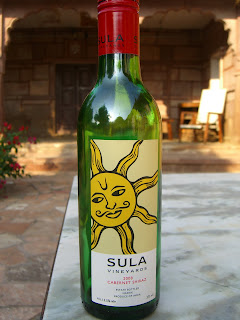
Sula Vineyards Cabernet Shiraz


Indian wine? Really?

Yes, yes, we all know that India is a country rapidly on the move, rich in intellectual capital, a world-class producer of pharmaceuticals, steel, IT services, aerospace technology, high-end skills. It also boasts a fantastic culinary tradition and just about every climatic variation known to man. But wine?


Well, put down those raised eyebrows and pay attention. Wine has been made in India for centuries, and the new Indian wine industry is actually nothing more than a resurgence of a well-established tradition. The biggest concentration of vineyards is not far from Mumbai; with a couple of smaller regions near Shimla (north) and Bangalore (south). Wine exports from India are increasing at an annual rate of around 9 per cent, while domestic consumption, fuelled by the growth of the new Indian middle class, is similarly on the rise. And the reason why I'm going on about Indian wine so flagrantly is because I've just got back from that country, and yes, it is fantastically exciting, eye-opening, dazzling, bonkers, all the platitudes. And I drank a bit of wine while I was out there.

Not a huge amount, because they were charging London prices, the equivalent of £20 a bottle if you're rash enough (I know I was) to ask for it in your boutique hotel. Nor could I find any cheaper wine at any of the numerous so-called Wine Shops we passed along the way, because the numerous Wine Shops seemed to sell only beers and spirits of a faintly intimidating nature, not wine, not the ones I went into.

The other restriction concerned the brand: because wherever you do see wine on offer, chances are it'll be from the Sula Vineyard, which seems to have colonised the territory fairly thoroughly, with its amiable branding (a smiley sun god, Surya, welcoming you to the label); serious investment in production and quality control (including India's first tasting room, designed by Californian architects, even); and entrepreneurial zip (the founder, Rajeev Samant, was a Silicon Valley wiseguy before getting stuck into the wine revolution). Sula now offers a range of over twenty different wines, reds, rosés, whites and sparkling, also no aversion to screwtops, a completely modern take on things, and a similarly modern desire to have the marketplace to themselves.

The pity of it is that I only seem to have drunk a half-bottle of the Cabernet Shiraz (maybe that's all they had) while staying in my 17th-Century Rajasthan gentleman's micropalace. False memory told me it was a whole bottle until I looked at the picture on my return home. Because, according to some notes I made in haste immediately after swigging it, it was pretty good. Rather daringly, I observed that it was low on tannin, but big and blackcurranty, and, conveniently cribbing from the notes on the back of the bottle, peppery. I also detected a round finish. Overall it reminded me of a thunderous and highly-prized Sicilian red that I tried at the Wine Show last year, the sort of wine whose arm around the shoulder seems to be about to turn into a headlock, but in a good way.

The label also suggested serving it chilled. Given that it was such a hairy-chested wine, not some effete Beaujolais production, this seemed perverse. I'm aware that the convention about room temperature reds can be overdone but I'm not absolutely persuaded that something so big, fruity and enveloping gains a lot from having the bottle lightly misted. On the other hand, given the temperature in much of India, much of the year (Indian joke: Dinner-party hostess to guests – 'Do come and sit down before the soup gets warm'), it may just be a precaution against the stuff mulling itself in the ambient heat.

At any rate I rather wish I'd had the other half, now, hot or cold, and hang the expense. Holiday nostalgia does that to you.

CJ