Thursday, 31 July 2014

Misled by the blind


I’ve been reading yet another of those damn fool blind tasting articles.

You know the ones I mean. The ones which “prove” that, when people don’t know what’s in their glass, they can’t tell an expensive Burgundy from a bargain plonk, or red wine from white wine, or white wine from petrol.

“Could YOU tell Lidl's £5.99 claret from a £595 Grand Cru?” asked the Daily Mail. “Our thirsty volunteers tried - with hilariously humiliating results”. 

Well, in this particular case, Oz Clarke was just about spot on with every one of the wines he sampled blind. He could indeed tell the £5.99 Lidl claret (“It’s reasonably nice from an average-tasting grape”) from the £595 Haut-Brion 1990 (“…reminiscent of pews in a cathedral…old and indulgent…This is the serious bottle.”) So presumably some of the “hilarious humiliation” rests with the Daily Mail itself. 

But what a ridiculous charade. Imagine, for instance, a blind comparison of trainers. You’re blindfolded, then you put successive pairs of trainers on your feet; after walking around in them, you have to say whether the pair you have on is the gobsmackingly expensive Nike/Prada collaboration, or the bargain Hi-Tecs from Sports Direct.

Sorry, what’s that you say? That you don’t buy trainers solely on the basis of a sensory response? That name, price and appearance all affect the way you feel about your trainers? Ah…

We do not ourselves host blind dinner parties. Although now I think of it, there have been times when I would have preferred certain guests to have bags over their heads.

So to me, the presentation of the wine is as important as the presentation of the food. Seeing the wine, with the anticipation it hopefully raises. The look of the bottle and label, even if people don’t necessarily recognise the name. The detail, the vintage, for those who are interested. Let my people see.

I actually find that even older gents with dodgy eyesight seem remarkably visually perceptive when a bottle of wine is concerned. (“Isn’t there a touch left in that bottle on the sideboard?”) Perhaps they should use claret labels in eyesight tests, whether for distance (“That looks like a Margaux to me…”) or for detail (“Oh I say, do I spy an ’82?”)

Of course some of us have decanted a wine before a meal, not because it needed it, but because we wanted to hide the label. Possibly because of its garish, crude design, which would somewhat diminish the elegance of the table. Perhaps because of its downmarket origin, suggestive of an unacceptable lack of generosity towards one’s guests. Probably because we didn’t want it to be spotted by someone who might also have seen it on a 3 for 2 offer. 

But when the wine has been good enough to actually merit decanting, I know I’m not alone in keeping the empty bottle on display, so that people can see what they’re drinking.

It’s been similarly “proven” that people find artistically presented food tastes better than food simply plonked on a plate. And I don’t find the fact that presentation alters our palate in this way particularly surprising. (In some circumstances it can even be rather convenient, as in “I’m sorry dearest but I cannot balance the fish on top of the carrots, which must be why it tastes funny.”)

So unless you’re going to share it “blind” with your guests, what’s the point in knowing how a wine is perceived without its visual information? And heaven knows what serving it “blind” would actually mean. That every time someone’s glass got low, you removed it to an adjacent room in order to fill it up unobserved? Or that the bottles are encased in bags, with the consequence that your table looks like a street-drinking convention? 

No, I’m afraid I want a wine to be judged as my guests will experience it – told what it is, shown how it looks, and being influenced by its name, its price and its appearance.

And I can tell you now, if I’m ever serving a £595 bottle of Haut-Brion, I will certainly want people to see it.

PK


Thursday, 24 July 2014

Double visions – the lookalike wine labels


When they said that drinking wine could leave you seeing double, this wasn't what I thought they meant. 

I would not wish you to think that I blunder along the shelves of my supermarket blearily plucking in desperation at anything that reminds me of a bottle of wine.

But I have only the time it takes Mrs K to negotiate the bread and baking aisles, during which I am left in the wine section, to choose the week’s wine and to come up with a plausible story for purchasing it. 

I’m looking for something that we really must have, we need to have, because of guests, or the weather, or something. And given the summer sun, what about that vinho verde from Azevedo I read about, lovely for drinking on its own in the garden. I recognise that tall bottle, that name, that label with an old building on it. And there can’t be that many items in the aisle with both ‘v’ and ‘z’ on their label, unless Sainsbury’s is now offering vajazzles.

Well. Of course, I was proven wrong. It turns out that what I bought is not the lovely Quinta de Azevedo, described as "Almost bone dry ... thirst-quenching ...sparky, floral, stone fruit” - Jane MacQuitty. Not the Quinta de Azevedo described as “Filigree-light, dry white with pure, clean flavours of pear, apple and lemon, and a delicate hint of spritz” – Suzy Atkins. No, this is Torre de Azevedo, described as “slightly syrupy, yellowish wine which gradually reveals, as the chill wears off, a certain slimy fruitiness, ending in an acidic attack to the throat like an onset of tonsilitis” – Sediment.

More fool me? Well sorry, but on a rushed morning in the supermarket, I didn’t expect to need a wine encyclopedia. I know, you shouldn’t judge a label by appearances, or a book by its cover – but if you see a book cover that looks like the one you remember, and it says JK Rowling on the spine, you’d be pretty copped off when you get home and realise it's an adventure of the lesser wizard Harry Pooter.

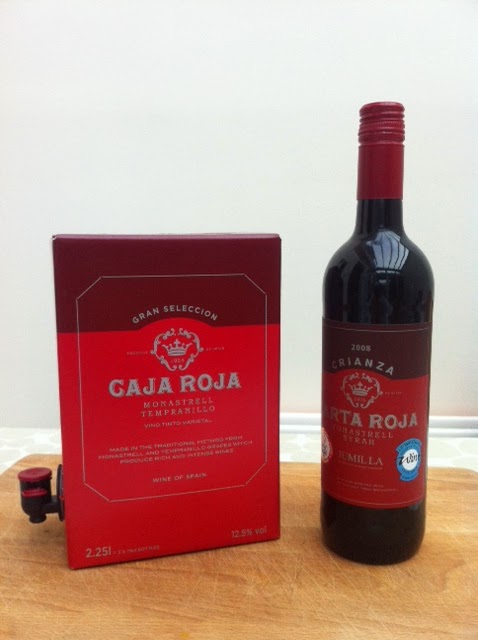
And this has happened to me before. Previously, in a short-lived exploration of wine in a box. I made the mistake of thinking that Caja Roja, in a box, was the same as the similarly packaged Carta Roja, in a bottle. I submit, m’lud, that any harrassed shopper would assume these two are the same wine:


They are not.

Am I the only person who is falling foul of this? The marketing people worry about wine being baffling to the average consumer – and then set them what amounts to a spot-the-difference test.

The discount store Lidl, for example, is planning to target upmarket London wine drinkers with some classy Bordeaux. ‘Lidl claret offensive’ said one headline, a statement which I felt read more like a tasting note than a marketing strategy.

Lidl will be selling, at £13.99, a wine from Chateau Siaurac, No, it’s not Chateau Siaurac itself; nor is it the second wine of Siaurac, which is Plaisir de Chateau Siaurac. But the ‘Reserve de la Baronne’ certainly looks like them:


Perhaps you can pick it out from the Chateau Siaurac line-up:

So before deciding whether a wine is the one you think it is, you have to master some kind of identification parade. A general memory of a name and a label, as I discovered, is no longer enough.

You can’t just send someone down the road to buy a bottle of wine based on your description of the label. “Oh, pick up a bottle of that red – it has a white label with a sort of circular device in red, like a Celtic symbol or something…” They might pass The Good Wine Shop, and bring back the bottle of Clonakilla, which you meant – or they might pass Oddbins, and bring back The Good Templar. Which you didn’t.


And a little knowledge can sometimes be more misleading than useful. I know, for example, of Chateau Ygay, a magnificent Rioja which I’ve tasted but can’t afford. So a label with similar type practically leaps at me from the Waitrose shelf:


The distinctive swirly red lettering, the additional gold swirly subtitle…could the significantly cheaper El Patito Feo perhaps be Ygay’s second wine? Are they by any chance related? 

No, sadly not. El Patito Feo is not even a Rioja; it’s actually from a different area of Spain. And while this upstart may be from the same country, it is not in the same Liga as Ygay.

No wonder people get taken in by fake wines, when it’s so easy to mistake the real ones. Confused at first sight, it’s little wonder some of us end up buying not quite the wine we thought.

Heaven forbid it could ever be a deliberate ploy…

PK


Thursday, 17 July 2014

Transportation: Muscadet Sur Lie

So by the time this appears, I should be in the family car speeding south somewhere in the depths of France, our indéchirable road map of the entire country sprawling aggressively across the front two seats, my wife growling at it like a dog with a chew toy. The sun should be shining, the towns and villages should be an indigestible French visual mix of manicured tourist honeypots and leaden pouvoir de l'état latterday municipal buildings, including but not limited to, salles polyvalantes, newbuild Mairies, local museums, 1980s artisanal markets, préfectures, police stations, go-ahead toilets and maisons de retraite. Assuming we can remember to operate according to that unspeakable provincial French timetable which only allows for anything to be open four hours a day (restaurants, especially), we should be fed and watered. The sunflowers will be out or I'll want to know the reason why, and we will have Django Reinhardt on the car stereo.

Which only leaves the drink. Inevitably there will be hundreds and hundreds of roadside inducements to stop'n'shop at hundreds and hundreds of winemakers' outlets. And we will have a car we can keep! Not one we have to give back at the airport! I ought to be able to fill the thing from floor to roof with wine, such that the wheel-arches wear the rear tyres smooth and the car takes bends like the coach at the end of The Italian Job on account of the massive weight of wine stuffed in the boot and spread over the back seat.

Only snag? Well, we're coming back a different way from the way we're going out. For all I know, the regions we pass through on the return leg don't even make wine. It's now or never for the stuff I'm currently going past. I should buy now, before it's all gone.

But if I start buying wine now, in a couple of weeks' time - when we catch the ferry home - it will have spent many days alternately jouncing around the C-roads of France, or mulling itself in the stationary sunshine. At the end of the last century, the wife and I were too young and idiotic to worry about these things, and we drove around with some Muscadet Sur Lie and a load of Pouilly-Fumé and didn't care what happened to it – hairpin bends, 40˚C, hours and hours of neglect, angry lorry drivers... we just let it suffer. And all I can remember subsequently is that, back in London, it tasted six times nicer than whatever the equivalent English price would have got us.

But now we labour under the crushing burden of third-hand advice acquired from people we don't know, and fret over horror stories of people leaving their cases of wine carefully parked up in the shade while they get outside a three-hour lunch, only to find the next day that they've simmered themselves twelve bottles of AOC consommé despite their best precautions. Whatever else befalls, it seems I must observe all of the following so as not to destroy my precious supplies: if the neck of the bottle starts to feel warm, that's the wine cooked; I must get myself a cooler box that plugs into the cigarette lighter; I must never turn the engine off and always keep the air-conditioning running (oh, really?); I must wrap each bottle individually in newspaper and put the newspapered bottles in a cardboard box; I must live in dread of bottle shock; I must definitely not transport unsulphured wines; I should have the stuff sent home by an international courier, they can keep it in good order, they have temperate trucks.

This is the looming contradiction: I am at the very heart of the wine world, but I am too craven to binge on the good things all around me. The answer it seems is to try and finesse the contradiction without actually fixing it. I can get all the booze I like, but only in the run-down to departure, and fingers crossed there'll be something I want to buy in Basse-Normandie, other than Calvados. Which means a couple of weeks spent hurtling past adorable stone châteaux and whimsical giant roadside wine bottles, places I know will have the drink of my dreams at a price I can live with, biting my lip and doing nothing, while my wife complains alternately at me and the indéchirable, that we're heading in precisely the opposite direction to the one we ought to be taking. What holidays are all about, I suppose.

CJ